How Did the Python Package Landscape Evolve in 2025? A Data-Driven Review
A data-driven analysis of trends, emerging packages, and shifts in popularity based on PyPI download statistics.
Introduction
How rapidly is the Python package landscape evolving? Have new stars emerged in the Python Package Index (PyPI) in 2025? Are shiny new packages threatening to make the ones we know obsolete? Was 2025 the year of AI agents as announced by some? Or the year Polars replaced Pandas? I analyzed PyPI download data between December 2024 and December 2025 to answer these questions and uncover the most significant trends and shifts.
New Python packages in 2025
At the time of writing (first two weeks of 2026), the Python Package Index (PyPI) hosts more than 700,000 packages. It also seems that over 100,000 of these were added in 2025. Did some of these baby packages already achieve some popularity?
Yes: over 100 packages first released in 2025 surpassed 1 million PyPI downloads in December 2025 only.
The standout example is typing-inspection, which achieved 311 million downloads in December 2025, ranking it as the 88th most downloaded package that month.
Note that I am using PyPI download counts, as queried from ClickPy, as a proxy for popularity. This has limitations, about which you can read in the last paragraph.
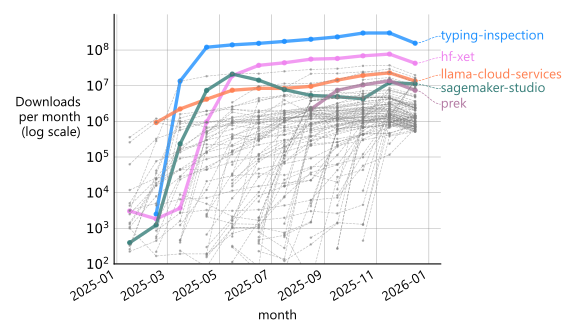
Notable new packages
The following packages - all first released in 2025 - have been selected based on their download counts and their representativeness.
| Package | Downloads (Dec. 2025) | First Release | Description |
|---|---|---|---|
typing-inspection | 311 million | 2025-02-13 | Provides runtime introspection tools for Python’s typing system, enabling developers to examine and manipulate type annotations at runtime. Used as a dependency by major libraries such as Pydantic and MCP. |
hf-xet | 85 million | 2025-01-10 | Enables fast and efficient transfer of large files with the Hugging Face Hub. Its adoption surged after Xet replaced Git LFS as the Hub’s storage backend. |
sagemaker-studio | 22 million | 2025-01-13 | Provides a programmatic interface for interacting with the new Amazon SageMaker Unified Studio, which has apparently seen rapid adoption. |
prek | 15 million | 2025-08-08 | A Rust-based reimplementation of pre-commit, offering faster performance for running code quality checks before commits. |
The largest growers
Beyond the newcomers described in the previous paragraphs, many existing Python packages saw impressive and sometimes explosive growth in 2025.
I looked for the largest increases in download counts between December 2024 and December 2025, both in absolute terms and in relative terms.
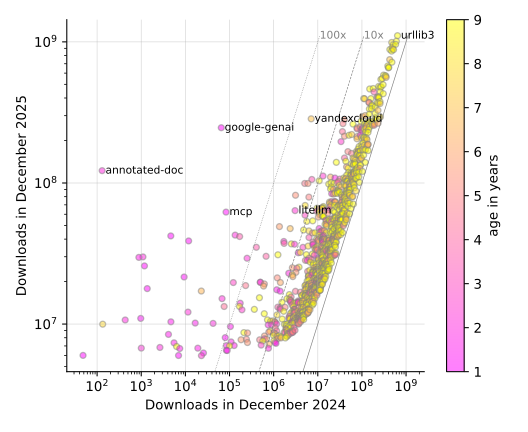
The following scatter plot with double log axis compares these download counts for the 1000 packages with the largest increases in absolute terms.
An interactive version of the scatter plot:
Look to the left for the highest relative growths and to the top right corner for well-established packages with strong absolute growth.
Top growers
Highest relative growth
It is easier to grow by large factors when you start small, as did the following packages, but their growth is nonetheless impressive.
annotated-doc(900,000x, to 122 million downloads in December 2025) automatically generates documentation based on type annotations. Its popularity is largely due to its integration with FastAPI, a popular and itself fast-growing package (see below).nvidia-cusparselt-cu12(30,000x, to 30 million downloads in December 2025) provides GPU-accelerated sparse matrix operations optimized for NVIDIA’s CUDA 12 platform. Its recent popularity surge (and that ofnvidia-cufile-cu12,nvidia-nvshmem-cu12) can be attributed to its integration with PyTorch and other deep learning tools.ty(100,000x, to 6 million downloads in December 2025) is a high-performance Python type checker, used bytyping-extensionsandpydantic.
Highest absolute growth
The following packages were already among the most downloaded packages in 2024, but managed to grow their monthly download counts by many millions.
typing-extensions(2x: 990 million downloads in December 2025 from 473 one year before) is this year’s winner in terms of absolute increase in PyPI downloads. It provides backported and experimental type hints for Python, extending the standard library’s typing module with features from newer Python versions. Its popularity has surged as major projects like Pydantic, Cryptography, and AioBotocore have adopted static typing.urllib3(+73%: 1106 million downloads in December 2025 from 641) enjoys strong and increasing popularity, which can be attributed to being a foundational dependency for widely-used projects like requests, botocore (AWS SDK), and huggingface-hub, making it a core component in modern web interactions, cloud services, and AI applications.aiobotocore(2x: 883 million downloads in December 2025 from 430) is an asynchronous Python client for AWS services. Its growing popularity can be compared to that ofbotocore,certifiandidna, which all testify to a growing use of networking libraries and cloud SDKs.mcp(700x: 62 million downloads in December 2025 from 0.08 one year before) is the Python package implementing the Model Context Protocol (MCP), a standardized interface for LLM interactions that enjoyed sudden popularity in 2025 and was adopted by major tools including Hugging Face Hub and LiteLLM.six(+70%: 674 million downloads in December 2025 from 386 one year before, despite no new release in 2025) really seems anachronistic, as its function is to provide compatibility utilities between Python 2 and Python 3. Its continued use as a dependency for many widely-used packages including setuptools, packaging, and python-dateutil resulted in renewed growth. The Python package ecosystem is not free of legacy dependencies.
Established packages
Many of the packages mentioned above may seem obscure to you, and you may wonder how the classics fared in 2025.
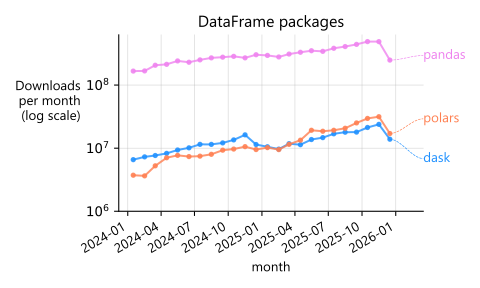
When it comes to handling tabular data, Pandas remains significantly more popular than alternative libraries, however fast or scalable these may be. Polars did outpace Dask but, as one year earlier and after steady growth on both sides, its monthly downloads remain one order of magnitude below Pandas.
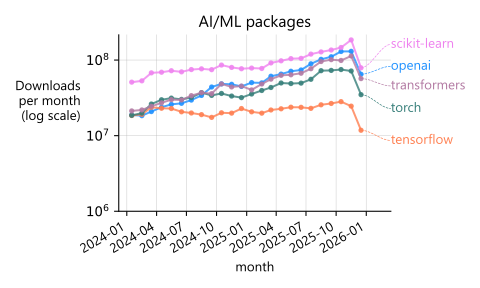
In the world(s) of artificial intelligence (AI) and machine learning (ML), the openai library now outpaces major frameworks like PyTorch and TensorFlow, reflecting the shift towards API-driven commoditized AI. However, scikit-learn retains its lead in the following chart, showing that Classic ML is not obsolete yet.
As for web frameworks, 2025 did see a change at the top, with FastAPI overtaking Flask and widening its lead over Django.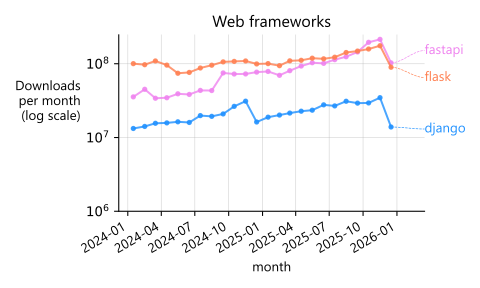
Summary of trends
The Year of LLM Agents?
AI agents were arguably more than a very successful buzzword in 2025, even if their definition seems to vary significantly from person to person. By the way, when you say agent, do you refer to autonomous self-orchestration of tool-using goal-driven AI systems with long-term memory and reasoning capabilities, or to anything with a language model?
Many of the new packages that achieved significant popularity in 2025 can at least be said to be AI/LLM-related, as epitomized by google-genai and mcp.
The latter, together with agent-focused packages like openai-agents and azure-ai-agents, highlights investments in actually agentic approaches, as does swe-rex, which enables sandboxed code execution for agents.
The rise of opentelemetry-sdk (78 to 246 million downloads) and related packages can be read as a sign of the growing importance of observability in AI systems.
Enterprise cloud
The cloud computing ecosystem saw significant growth in Python SDK downloads throughout 2025.
Leading the way were botocore, the foundation of AWS’s Python ecosystem, which
surged past 1 billion downloads, and its async counterpart aiobotocore, which showed even stronger relative growth.
Other cloud providers, including Google and Azure, also participated in this growth.
The most remarkable increase might be that of yandexcloud, the official SDK for the Russian Yandex Cloud, from just 7 million to 285 million downloads.
Typing
As already seen with typing-extensions and typing-inspection, the Python typing ecosystem saw substantial growth in 2025.
Both annotated-types and pydantic also showed strong momentum.
Pydantic’s performance-focused second version continued to drive adoption, with its Rust-based pydantic-core seeing downloads increase from 188 million to 442
million.
Rust integration
The use of Rust for performance-critical components of Python packages is a strong trend, beyond the already mentioned Polars and pydantic-core.
This is also exemplified by prek (see above), rpds-py, which provides Python bindings to Rust’s persistent data structures and has increased from 104 to 242 million downloads, fastar (first release in October 2025 and already several millions downloads per month) and uv-build, the new build backend for the fast all-in-one Python package and project manager uv.
Final thoughts
Even if download metrics should be considered with caution (see below), I am quite confident in my conclusions: enterprise cloud adoption continued to accelerate, type hints are becoming increasingly mainstream and Rust-powered performance optimization is spreading across the Python package ecosystem. Also, LLM-powered API-driven AI development continued growing, along with newer agentic AI workflows, but this does not render classic packages obsolete.
Beyond packages, the Python language itself also kept evolving in 2025. Consider the release of Python 3.14, with its official support of free-threading. And I am not even talking about other factors impacting developer experience.
Did these trends affect your Python workflow in 2025? Are you anticipating other ones in 2026? And what were your Python highlights of 2025?
Sources, disclaimer and references
Most PyPI download numbers referenced in this article were extracted from ClickPy, a Python Package Analytics Service Powered by ClickHouse available at clickpy.clickhouse.com. ClickPy itself is based on the public PyPI download statistics dataset made available on Google BigQuery, which you can read about in the section on Analyzing PyPI package downloads of the Python Packaging User Guide.
The Python Packaging User Guide itself claims that these download statistics are “highly inaccurate” and “not particularly useful”. Indeed, as I wrote in March 2025, Trying to Make Sense of PyPI Download Statistics is not easy. I do believe that these statistics can be useful, especially for analyses comparing numbers from one year to the next, and provided you take the numbers with a grain of salt and understand some of their drivers.
For those eager to dig into the numbers on their own, I compiled the three following lists on PySpect: most downloaded new packages of 2025, packages with highest relative PyPI growth in 2025 and with highest absolute PyPI growth in 2025.