Area chart
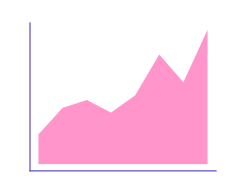
Definition
Chart using filled areas to show the evolution of a quantity
Also known as
Area graph, filled line chart, mountain chart
Summary
An area chart displays quantitative data over a continuous interval or time period, where the area between the axis and a line is filled with color or shading. It functions similarly to a line chart but emphasizes the magnitude of values by filling the space below the line. Area charts are particularly effective for showing cumulative totals and overall volumes across time.
Anatomy
- X-axis: Typically represents a continuous variable, most commonly time (days, months, years)
- Y-axis: Represents the quantitative value being measured
- Line: Traces the data points across the chart, connecting values at each interval
- Fill: The colored or shaded region between the line and the baseline (usually zero)
- Baseline: The reference line from which the area extends, typically positioned at zero or another meaningful value
- Data points: Individual measurements that define the line’s path, though not always explicitly marked
Interpreting a area chart
Readers interpret area charts by following the upper boundary line to track changes in values over the horizontal axis. The filled area provides a visual representation of cumulative magnitude, making it easier to perceive the overall volume or mass of the data. When comparing multiple series in a stacked area chart, the vertical distance between boundaries represents each category’s contribution, while the topmost line shows the total. In overlapping area charts with transparency, readers can distinguish individual series while still perceiving where they intersect or diverge.
When and how to use a area chart
Strengths
- Effectively communicates cumulative totals and overall magnitude of change
- Makes trends and patterns easily recognizable through visual mass
- Works well for showing part-to-whole relationships when stacked
- Creates strong visual impact that helps viewers grasp the scale of data
- Suitable for displaying continuous data with no gaps in the time series
Caveats and limitations
- Multiple overlapping series can obscure data, making precise values difficult to read
- Stacked area charts make it challenging to compare individual series that don’t share the baseline
- The filled area can create visual weight that may overemphasize certain patterns
- Inappropriate for data with negative values unless using a diverging baseline
- Can be misleading if the Y-axis doesn’t start at zero, as the filled area implies cumulative quantity
- Not suitable for sparse or discontinuous data where gaps exist
Use cases
- Tracking financial metrics over time, such as revenue or expenses
- Showing resource consumption, energy use or inventory levels across periods
- Illustrating demographic changes or population trends
Recommendations
Start the Y-axis at zero to maintain visual integrity, as the filled area implies a quantitative relationship to the baseline. Limit the number of series to avoid clutter: use no more than three or four categories in stacked area charts. Consider using transparency or small multiples when comparing multiple non-stacked series. Reserve stacked area charts for situations where the total is meaningful and individual series do not require precise comparison.
Links
Wikidata entity: Q390083 (area chart)
Wikipedia page: Area chart