Heat map
Definition
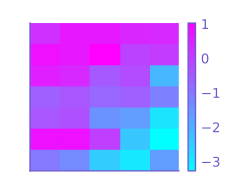
Graphic representing data in a two-dimensional matrix, encoding values as colors
- superclass of temporal heat map
Also known as
Heatmap, heat chart, matrix chart, shaded matrix, color-encoded matrix
Summary
A heat map is a data visualization technique that displays values in a two-dimensional matrix using color gradients to represent values. Each cell in the matrix corresponds to a specific combination of row and column variables, with the color intensity or hue indicating the cell value. This approach allows viewers to quickly identify patterns, correlations, and outliers across large datasets through visual perception of color differences.
Anatomy
- Grid structure: A rectangular matrix of cells arranged in rows and columns
- Axes: Two categorical or discrete variables that define the dimensions of the matrix
- Color scale: A continuous or discrete gradient mapping data values to colors
- Legend: A color key that explains the relationship between colors and numerical values
- Cell labels: Optional numerical labels displayed within cells for precise reading
- Axis Labels: Text identifying categories along both axes
Interpreting a heat map
Reading a heat map involves identifying patterns through color distribution rather than precise numerical comparison.
The intersection of any row and column defines a specific data point, allowing comparison across both dimensions simultaneously. Patterns may emerge as horizontal or vertical bands, diagonal trends, or isolated hotspots.
When and how to use a heat map
Strengths
- Efficiently displays large datasets in a compact space, making thousands of data points comprehensible at once
- Enables rapid pattern recognition through preattentive processing of color
- Facilitates comparison across two categorical dimensions simultaneously
- Reveals correlations, clusters, and anomalies that might be obscured in tabular format
- Works well for temporal patterns when one axis represents time periods (see temporal heat map)
Caveats and limitations
- Color perception varies among individuals, particularly for those with color vision deficiencies
- Precise value comparison is difficult without numerical labels, as humans struggle to distinguish subtle color differences
- Inappropriate color scales can mislead or obscure patterns in the data
- The arbitrary ordering of categories can create false patterns or hide meaningful relationships
Use cases
- Correlation matrices showing relationships between multiple variables
- Website analytics displaying user activity by time of day and day of week
- Performance metrics across products and time periods
Recommendations
Order rows and columns meaningfully if applicable (e.g. chronological ordering). If there is no natural ordering, consider using hierarchical clustering or seriation techniques to reveal structure.
Choose color schemes appropriate to the data type: sequential gradients for continuous data, diverging schemes for data with a meaningful midpoint.
Links
Wikidata entity: Q1140423 (heat map)
Wikipedia page: Heat map