Line chart
Definition
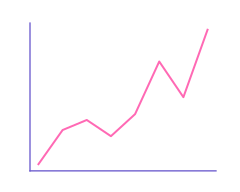
Chart using lines to show the evolution of a quantity
Also known as
Line graph, line plot, curve chart
Summary
A line chart displays quantitative data as a series of points connected by straight line segments. It excels at showing trends, patterns, and changes in values over continuous intervals, most commonly time.
Anatomy
A line chart consists of:
- Axes: A horizontal axis (x-axis) representing the independent variable, usually time or another continuous scale, and a vertical axis (y-axis) showing the dependent variable being measured
- Data points: Individual values plotted at specific coordinates where measurements were taken
- Line segments: Straight lines connecting consecutive data points to show continuity
- Labels and scales: Numerical or categorical markers along each axis to indicate values
- Legend: When multiple lines are present, a key identifying what each line represents
- Grid lines (optional): Background reference lines that aid in reading precise values
When and how to use a line chart
Strengths
- Effectively communicates trends and patterns over continuous intervals
- Enables easy comparison of multiple data series on the same chart
- Shows rates of change through line slope, making acceleration or deceleration visible
- Familiar format that most audiences can interpret quickly
Caveats and limitations
- Assumes continuity between data points, which may misrepresent discrete or irregular measurements
- Can become cluttered and difficult to read when displaying too many lines simultaneously
- May suggest false precision when connecting sparse data points
- Less effective for comparing values at specific points than bar charts
Recommendations
Choose a line chart when your primary goal is to show how values change over a continuous scale, particularly time. Limit the number of lines to four or five to maintain readability; consider using small multiples or separate charts for more complex comparisons.
Ensure the x-axis represents an ordered, continuous variable and space data points proportionally to their actual intervals. Use clear, contrasting colors or line styles to distinguish multiple series, and include a legend positioned where it does not obscure data.
Consider whether starting the y-axis at zero is appropriate for your data context, as truncated axes can exaggerate changes but may be necessary to show meaningful variation. Add data point markers when measurements are sparse or when emphasizing specific values is important. Provide clear axis labels and titles to establish context without requiring additional explanation.
For multiple lines, consider direct line labeling as an alternative to a legend.
Links
Wikidata entity: Q776115 (line chart)
Wikipedia page: Line chart