Node-link diagram
Definition
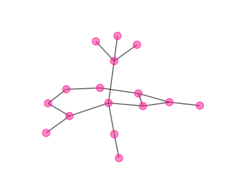
Graph visualization in which the vertices are represented as point-like nodes (such as disks or boxes) and the edges are represented as line segments or curves.
visualizes graph data
can use edge bundling
superclass of
Also known as
Node-link diagram, network diagram, graph visualization, network graph, force-directed graph
Anatomy
A node-link diagram consists of two primary visual elements:
Nodes represent entities or data points. These are typically rendered as circles, dots, or other shapes. Nodes may vary in size, color, or style to encode additional attributes such as importance, category, or quantitative values.
Links (also called edges or connections) represent relationships between nodes. These appear as lines or curves connecting pairs of nodes. Links may be directed (with arrows indicating relationship direction) or undirected. Visual properties like thickness, color, or line style can encode relationship strength, type, or other attributes.
An important aspect of node-link diagrams is the positioning of nodes, which in general is not determined by the data but rather derived from the actual graph connectivity using some layout algorithm.
Interpreting a node-link diagram
Various patterns in the network structure can be identified by contemplating a node-link diagram:
- Connectivity: The number and pattern of links attached to each node indicate its role in the network
- Clusters: Groups of densely connected nodes suggest communities or related entities
- Central nodes: Nodes with many connections often represent important or influential entities
- Paths: Sequences of links between nodes show how entities are indirectly related
- Isolated components: Disconnected groups of nodes indicate separate subnetworks
When and how to use a node-link diagram
Strengths
- Intuitive representation of relationships and connections between entities
- Reveals network structure, including clusters, hubs, and isolated components
- Supports exploration of both local neighborhoods and global patterns
- Accommodates various data types through node and link attributes
- Enables identification of key nodes based on connectivity patterns
Caveats and limitations
- Becomes cluttered and difficult to read with large networks (typically beyond several hundred nodes)
- Link crossings create visual confusion and interpretation challenges
- Layout algorithms may produce different arrangements from the same data, affecting perception
- Spatial proximity may be misinterpreted as meaningful when it results only from layout constraints
- Quantitative comparison between nodes or links can be imprecise
- Performance issues arise with interactive exploration of large networks
Use cases
Most instances of graph data, such as:
- Social network analysis (friendships, collaborations, influence patterns)
- Organizational structures and reporting relationships
- Citation networks
- Computer network topology and system architecture
- Biological networks (protein interactions, food webs, neural connections)
- Transportation and logistics networks
- Dependency mapping in software systems