Seriation
Definition
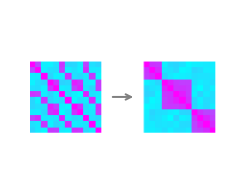
Ordering of the rows and columns of a matrix so that similar items are placed next to each other, revealing structure in the data
applies to tabular data
can be used by
Also known as
Seriation, matrix reordering, matrix permutation
How it works
Seriation finds an order for the rows and columns of a matrix (or for the items of a one-dimensional sequence) that places similar items next to each other. The data values are unchanged. Only their arrangement differs.
Common approaches include:
- Hierarchical clustering order: Use the leaf order of a dendrogram, often with optimal leaf ordering
- Spectral ordering: Sort items by the values of an eigenvector of a similarity matrix
- Ordering by a summary statistic: Sort items by degree, row sum or mean value
- Optimization methods: Minimize a criterion such as the distance between neighboring items
When and how to use seriation
Strengths
- Reveals clusters, gradients and outliers that an arbitrary order hides
- Works with any matrix chart, without changing the encoding
Caveats and limitations
- Different methods can produce quite different orders from the same data
- Finding an optimal order is computationally hard for large matrices, so most methods are heuristics
- A strong pattern after reordering can be partly an artifact of the method
Use cases
- Ordering rows and columns of a heat map
- Revealing clusters in an adjacency matrix
- Relative dating of archaeological finds, where the technique originated
Links
Wikidata entity: Q48968948 (seriation)
Wikipedia page: Seriation (statistics)